

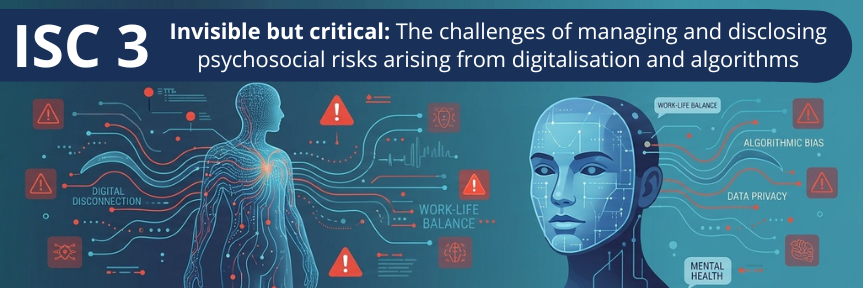
ISC. 3. Invisible but critical: The challenges of managing and disclosing psychosocial risks arising from digitalisation and algorithms
General Information
Venue: ETSIA, Campus Bahía de Algeciras.
Dates: July 13-17
Duration: 30h
Field of Knowledge: Financial Economics and Accounting, Business Organization, and Social Psychology
Number of places: 25
Course Coordinator: Nieves Gómez Aguilar y María José Foncubierta Rodríguez
Coordinator’s email: nieves.gomez@uca.es mariajose.foncubierta@uca.es
Language: English and Spanish
ECTS recognition is requested
Target Audience: Students, PDI and PTGAS
Course Description
International organisations (ILO, OECD, EU-OSHA, European Commission, European Parliament, WHO, etc.) and scientific literature on the subject are highlighting the emergence of a series of new psychosocial risks arising from the accelerated process of digitalisation in organisations and the incorporation of AI into their management. In turn, international regulatory bodies and professionals have proposed guidelines and regulations for the disclosure of those impacts, risks and opportunities that affect workers’ health (International Sustainability Standards Board (ISSB), Global Reporting Initiative (GRI), European Financial Reporting Advisory Group (EFRAG)). The disclosure of information on these risks will facilitate decision-making to create a healthier working environment.
This programme offers a comprehensive overview of these emerging psychosocial risks arising from the present and future context of digitalisation, hyperconnectivity and the reign of algorithms, such as technostress, techno anxiety, digital exhaustion, difficulty disconnecting digitally, the digital divide, the fear of losing agency (meaning at work), dehumanisation, and the impact of AI in general. It will be approached from a threefold perspective: social psychology, strategic management and information dissemination. In a business environment where value no longer resides solely in tangible assets, the organisation’s mental health becomes a critical indicator of sustainability. It is also a mechanism for complying with the Sustainable Development Goals (SDGs), such as SDG-3 (Good Health and Well-being), SDG-8 (Decent Work and Economic Growth), SDG-5 (Gender Equality), SDG-10 (Reduced Inequalities), and SDG-4 (Quality Education).
Over the course of five sessions, trainees will analyse how to identify these risks, how to assess them, what intervention measures are recommended (integrating them into Corporate Social Responsibility (CSR) policies and strategies) and, in addition, how to comply with the new requirements for sustainability information disclosure (ISSB, GRI, NEIS). In this sense, the course combines the technical rigour of sustainability reporting with talent management tools, equipping participants with the skills needed to lead more resilient, transparent, and humane organisations. This is what the literature currently refers to as companies with ‘human-centric management’, in the face of the arrival of algorithms (efficiency/humanisation).
This programme is useful for undergraduate and Master’s students who want to develop their professional career in areas such as Management, Human Resources, Accounting and Social Psychology applied to companies and other organisations. It is also useful for professionals who wish to update their knowledge of emerging psychosocial risks and the requirements and recommendations for disclosing information in sustainability reports. Due to its scientific and technical profile, it will also be useful for researchers in any of the above fields, as well as for technical administration and management staff interested in occupational health and well-being.
The teaching methodology will be fundamentally practical, with participation from company executives who will demonstrate how psychosocial risks are identified, managed, and disclosed. There will also be a visit to a large company in the Bay of Algeciras, which will serve as the basis for an assessable project to be carried out by the students.
Course Objectives
Upon completion of this programme, students will be able to:
- Identify and Assess Emerging Psychosocial Risks: Understand the nature of new psychosocial risks (stress/technostress, digital burnout, difficulty disconnecting digitally, fear of lack of cybersecurity and automation, and the impact of AI, the digital divide, etc.).
- Integrate Mental Health into Strategy: Design proposals to include well-being in organisational policies, in compliance with CSR principles and SDGs.
- Develop leadership styles that promote psychosocial well-being: Learn and develop leadership skills in styles that contribute to creating a climate of satisfaction and psychosocial well-being for members of organisations in environments undergoing technological transformation.
- Master disclosure frameworks and requirements: Study how the company should include psychosocial risks in its information disclosure strategy. Apply current regulations for the preparation of employee information. Understand health disclosure indicators and know how to analyse their relevance, timeliness and clarity.
- Analyse intangible assets: Assess the relationship between workplace wellbeing, sustainability and company value.
- Transfer knowledge: Diagnose real situations through case studies and direct visits to companies.
- Promote research: Identify opportunities for original research and updating scientific content in the field of psychosocial health management in the workplace, and the dissemination of sustainability information.
Participant requirements
- Undergraduate and Master’s students from any university—Spanish or foreign—preferably those from the fields of Business, Sustainability, and Workplace Safety.
- Teaching and research staff, mainly from the fields of Business Organisation, Accounting, and Social Psychology, as well as PTGAS, given the scientific and technical basis of the training and the interest in the subject matter.
- Other individuals with an interest or responsibility in human resources management, as well as in the dissemination of sustainability information related to worker health and safety, with a special focus on psychosocial health derived from the digital/algorithmic (AI) context.
- Participants must have a laptop or tablet.
- An intermediate level of English and Spanish is required.
Course Programme
The course consists of six sessions covering the following content.
SESSION 1 Monday, 13 July
9–10 a.m.: Activities to get to know the students and introduce the teaching staff.
10–11 a.m.: Activity to understand the problem the course aims to address.
11:30-14:30 a.m.: Emerging psychosocial risks in the workplace. The need for human-centric management in the face of digitalisation and algorithms. Initial practice.
SESSION 2 Tuesday, 14 July
9–10 a.m.: Emerging psychosocial risks in the workplace. The need for human-centric management in the face of digitalisation and algorithms.
10–11 a.m.: Practical activities.
11:30-14:30 a.m.: Mechanisms for managing psychosocial health in the workplace, with special emphasis on emerging psychosocial risks.
SESSION 3 Tuesday, 14 July
3.30-5.30 p.m.: The role of leadership in the digital/algorithmic context.
5.30-8.00 p.m.: Practical activities.
SESSION 4 Wednesday 15 July
9-11 a.m.: Transparency and disclosure of information on workers’ health.
11:30-14:30 a.m.: Analysis of materiality and the value chain in relation to workers’ health.
SESSION 5 Wednesday 15 July
3.50-5.30 p.m.: Practical activities.
5.30-8.00 p.m.: Preparation and presentation of the final assessment project.
Thursday 16 July: Public holiday in Algeciras.
SESSION 6 Friday 17 July
9.00 a.m.: Take the bus from the main door of ETSIA.
9.30 a.m.-1.30 p.m: Learn about the identification, assessment, management and disclosure of psychosocial risks in ACERINOX, a large company in the Bay of Algeciras.
1.30 p.m. Return by bus to the ETSIA.
Assessment
A) Block-Based Assessment
- Sessions 1–2 – Emerging Psychosocial Risks
- Practical tasks:
- Application of tests based on validated scales.
- Analysis and interpretation of results.
- Proposal of intervention measures.
- Outcome: Pass / Fail.
- Practical tasks:
- Session 3 – Leadership
- Activity: Human-Centric Leadership Pitch (group).
- Objective: Design and present a human-centric leadership model in a digital, algorithmic business context. Integrate psychosocial risk assessment, leadership principles, and organizational measures.
- Presentation: Simulated before the company’s Management Committee.
- Sessions 4–5 – Information Disclosure
- Group activity (10 points total):
- Extract key sustainability information: 2 points
- Analyse the information: 3 points
- Critically review materiality matrix and worker health disclosure: 5 points
- Group activity (10 points total):
B) Final Assessment Gymkhana – “Mission: Human-Centric Rescue”
Dynamics:
- 5 stations (one per session), sequential challenges to “save” a fictional company from a toxic algorithm.
- Hybrid teams (students, executives, staff, researchers, third parties).
- Each team has a “Work Health Passport” stamped after each task.
Stations and tasks:
- The Algorithm Maze: Match work situations with psychosocial risks in under 3 minutes.
- The Psychosocial First Aid Kit: Allocate a fictitious budget to long-term psychosocial health measures.
- The Leadership Translator: Rewrite a cold automated email into a human-centric leadership message.
- Communicating the Truth: Extract key data from a technical report and create a clear, transparent message (≤280 characters).
- The Value Chain Domino Effect: Place puzzle pieces representing stakeholders to show chain impact of a risk event. Fastest team earns an extra point.
C) Final Group Project
- Based on Gymkhana teams.
- Objective: Develop a proposal to identify, measure, manage, and disclose a specific psychosocial risk in a real company.
- Assessment:
- Proposal preparation.
- Defense before peers and faculty.
- Evaluation criteria: Compliance with regulations, adaptation to the company, quality of references, and comprehensive understanding of the problem.
Teaching Staff
| Gómez Aguilar, Nieves | Department of Financial Economics and Accounting, UCA |
| Foncubierta Rodríguez, María José | Department of Business Organization, UCA |
| Holgado Herrero, Magdalena | Department of Social Psychology, UCA |
| Conesa Carril, María | Department of Financial Economics and Accounting, UCA |
| Perea Vicente, José Luis | Department of Business Organization, UCA |
| Ferullo, Diana | Department of Management and Innovation Systems, University of Salerno (Italy) |
This course is supported and sponsored by:
- The Faculty of Economic and Business Sciences will act as guarantor and provide financial support.
- The Vicerrectorate of Algeciras Bay will provide financial support.
- The research groups (SEJ-058 and SEJ-366) act as scientific guarantors.
For any questions, please contact the coordinator of this course