

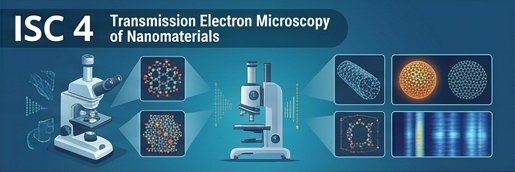
ISC. 4. Transmission Electron Microscopy of Nanomaterials
General Information
Venue: Faculty of Sciences, UCA
Dates: July 13-17
Duration: 30h
Field of Knowledge: Inorganic Chemistry
Number of places: 24
Course Coordinator:José Antonio Pérez Omil
Coordinator’s email: jose.perez-omil@uca.es
Language: English
ECTS recognition is requested
Target Audience: Students, PDI and PTGAS
Registration Fee: 720€
More information at: tem.uca.es
Course Description
The TEM-UCA Summer School offers an in-depth review of the latest advances in Transmission Electron Microscopy (TEM), covering both imaging and spectroscopic techniques for the characterization of nanomaterials. The workshop, designed for researchers, students, and professionals, is limited to 24 participants to ensure a personalized learning experience.
Several speakers will demonstrate how various scanning/transmission electron microscopy techniques (TEM/STEM), both those providing structural information at the atomic scale and analytical/spectroscopic methods, can be combined to obtain comprehensive information about materials at the atomic level. Practical aspects of nanomaterial characterization and their applications in different fields will be illustrated through hands-on examples and case studies.
Using a practical methodology, participants will be divided into two groups to master key software applications in the TEM/STEM field. Sessions will cover everything from nanoparticle modeling and High-Resolution Electron Microscopy (HREM) image simulation to advanced techniques such as Electron Energy Loss Spectroscopy (EELS), X-ray Energy Dispersive Spectroscopy (XEDS), and Electron Tomography (ET). This training is complemented by a practical session on microscopes equipped with spherical aberration correctors, located in the Electron Microscopy Division of the Central Research Services.
The ability to visualize nanostructures at the atomic scale is key to understanding the physicochemical properties of matter. Using spectroscopic techniques in sub-nanometer regions, it is possible to map local chemical composition, oxidation states, and electronic properties of elements. Additionally, electron microscopy allows exploration of the overall electronic structure, providing critical data on the band gap or the presence of surface plasmons. Finally, 3D reconstruction through tomography offers a comprehensive view of nanomaterial morphology and volume.
Currently, TEM-UCA is managed by FundUCA and offered as a training course for the entire scientific community. It is organized within the FQM-334 group of the Department of Materials Science, Metallurgical Engineering, and Inorganic Chemistry, as well as the Institute of Electron Microscopy and Materials (IMEYMAT), with the support of the Faculty of Sciences and the Vice-Rectorate for Research at UCA. It is also offered as a training course in the Nanoscience and Materials Technology PhD program, taught at the Faculty of Sciences.
Course Objectives
The primary objective is to equip participants with the essential skills and tools to rigorously interpret images, spectra, and data obtained from state-of-the-art STEM/TEM microscopes. In this way, attendees will be able to extract critical, high-value scientific information directly applicable to their respective research projects.
Beyond technical training, this initiative aims to consolidate UCA’s Electron Microscopy node as an international benchmark in research, application, and teaching. With an uninterrupted trajectory since 2001—except for the pandemic hiatus—the TEM-UCA School has annually trained groups of 24 to 36 researchers. The program’s prestige is supported by the participation of leading European microscopy experts, positioning UCA at the forefront of scientific training.
Additionally, a key objective of the school is to highlight the cutting-edge scientific infrastructure available at UCA. In this regard, it is worth noting that our Electron Microscopy Division is a fundamental component of ELECMI, Spain’s Singular Scientific and Technical Infrastructure (ICTS) for electron microscopy. As one of the four strategic national nodes—alongside Madrid, Barcelona, and Zaragoza—UCA provides the scientific community with unique instrumental capabilities in the country.
Participant requirements
Graduates, degree holders, and engineers in any Science Degree. Students, in general, in the field of Science and Technology, intending to deepen their knowledge in the field of Transmission Electron Microscopy.
Registration
Registration Fee: 720€. This covers attendance to lectures and labs in Faculty of Science, lodging at the “Colegio Mayor de la Universidad de Cádiz” in Cádiz from Sunday (Check-in) to Friday (Check-out), coffee breaks, lunch, printed materials and an all-together school evening dinner or special event.
A rate of 500 € will apply to those who do not need accommodation at the Colegio Mayor in Cadiz.
Please note that a special discount is available for members of the “Institute of Electron Microscopy and Materials (IMEYMAT)”. To claim this rate, ensure your membership is correctly indicated on the registration form.
Course registration and details: Check all the necessary information at tem.uca.es
Course Programme
| Monday | Tuesday | Wednesday | Thursday | Friday | |
| 09:30 – 11:00 | Talk 1 | Talk 2 | Talk 3 | Talk 4 | A6 / B1 |
| 11:30 – 13:00 | Lab 0 | A1 / B6 | A1 / B6 | A6 / B1 | Talks 5, 6 |
| 14:00 – 17:30 | A2 / B3 | A3 / B2 | A4 / B5 | A5 / B4 | |
| Social Event |
Talks
Note: The lectures will take place in the main hall (Salón de Grados II).
Labs
Note: Two groups, A and B, will be created (12 persons each) for the computer labs (Labs L2-L6). For the microscopy sessions (Lab L1) the groups A and B will be divided into two subgroups once more (6 persons each).
Assessment
During the TEM-UCA school, daily attendance is monitored and duly reported to FundUCA at the end of the program.
During the practical sessions, both at the computer and on the microscope, in small groups, the instructor carries out a series of exercises and activities, ensuring that all tasks are completed correctly and that no student falls behind. This year, multiple-choice quizzes will also be conducted to ensure proper assimilation of the course content.
Teaching Staff
| José Juan Calvino | UCA – Departamento de Ciencia de Materiales, Ingeniería Metalúrgica y Química Inorgánica |
| Susana Trasobares | UCA – Departamento de Ciencia de Materiales, Ingeniería Metalúrgica y Química Inorgánica |
| Ana B. Hungría | UCA – Departamento de Ciencia de Materiales, Ingeniería Metalúrgica y Química Inorgánica |
| Miguel López-Haro | UCA – Departamento de Ciencia de Materiales, Ingeniería Metalúrgica y Química Inorgánica |
| Ramón Manzorro | UCA – Departamento de Ciencia de Materiales, Ingeniería Metalúrgica y Química Inorgánica |
| Luc Laujanie | UCA – Departamento de Ciencia de Materiales, Ingeniería Metalúrgica y Química Inorgánica |
| José A. Pérez-Omil | UCA – Departamento de Ciencia de Materiales, Ingeniería Metalúrgica y Química Inorgánica |
| María Luisa Ortiz | Universidad Complutense de Madrid – Química Inorgánica |
| Quentin Ramasse | SuperSTEM Laboratory (Daresbury) – Reino Unido |
| Peter van Aken | Max Planck Institute for Solid State Research (Stuttgart, Germany) |
| Patricia Abellán | Institut des Matèriaux de Nantes Jean (Nantes, France) |
| José María Geraldía | UCA – División de Microscopía Electrónica de los Servicios Centrales de Investigación Científica y Tecnológica |
| Esther Chinchilla | UCA – División de Microscopía Electrónica de los Servicios Centrales de Investigación Científica y Tecnológica |
| Company Talks | Thermo-Fisher & IZASA & Gatan |
This course is supported and sponsored by:
- Intituto de Microscopía Electrónica y Materiales (IMEYMAT)
- Departamento de Ciencia de Materiales, Ingeniería Metalúrgica y Química Inorgánica
- Facultad de Ciencias, UCA
For any questions, please contact the coordinator of this course
More information at: tem.uca.es