

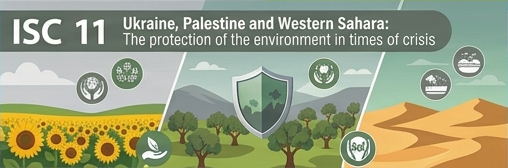
ISC. 11. Ukraine, Palestine and Western Sahara: The protection of the environment in times of crisis
General Information
Venue: Cádiz
Dates: September 14-18
Duration: 40h (30h hours in person)
Field of Knowledge: Law
Number of places: 25
Course Coordinator: Olena Nihreieva
Coordinator’s email: olena.nihreieva@uca.es
Language: English
ECTS recognition is requested: 1 credit ECTS
Target Audience: Students and PDI
Course Description
One of the main collective interests of the international community and the primary purposes of modern international law is the protection of the environment, which is cross-cutting for the Sustainable Development Goals of the 2030 Agenda. Being indispensable to the survival of humanity, the environment, as a global public good, has suffered serious damage, primarily as a result of economic activities. Nowadays, effective national environmental legislation can be found in many countries. However, such protection remains fragmented that diminishes the overall effectiveness of the protection of the environment as a whole. Additionally, protection granted to the environment in peacetime is often absent during wartime that underminesthe efforts made previously at the national level or in neighboring countries. In this regard, legal professionals and practitioners from other fields need a deep understanding and solid knowledge of law governing the protection of the environment at the international and EU levels in both peace and wartime. This includes the rules on the conduct of hostilities that aim to protect the environment as well as environmental human rights that may be violated in this context. Finally, from the practical perspective, it might be important to gain knowledge about the mechanisms of compensation for environmental harm that can help ensure accountability and bring transgressors to justice. This knowledge will be useful for scholars, practitioners and other members of civil society.
The course provides detailed information on the rules and doctrine of several key branches of public international law, namely: international environmental law, international humanitarian law, the law of the sea, and EU environmental law. Theoretical studies of the above issues are combined with their practical analysis through case-studies activities dedicated to several armed conflicts, among which the current situations in Ukraine, Palestine and Western Sahara are the most relevant since they affect the international order as a whole. It is worth mentioning that the proposed programme is innovative due to the lack of scientific and mass-media attention to the issues of environmental harm in these conflicts, particularly, in Western Sahara. Thus, the introduction of the course will hopefully attract more attention to this problem.
The course offers a comprehensive legal analysis of the above situations and provides a solid foundation for a legal assessment of these events. It will be useful for anyone who follows recent events in international relations and seeks to understand them from a legal perspective.
Course Objectives
At the end of the course students will be able to assess, both holistically and in context, the main rules and doctrines of public international law relating to the protection of the environment and human rights in peacetime and the rules of international humanitarian law applicable to the protection of the environment in wartime. Due to its specificity and its relevance for Spain and other European states, the protection of the marine environment will be considered separately. The normative framework will be completed by focusing on the EU environmental legal regulation shaping national policies in EU Member States. Special attention will be paid to case studies on environmental protection in Palestine, Ukraine, and Western Sahara facing the extreme pressure of ongoing armed conflicts. Students will also develop the necessary tools to reflect critically on some of the most important problems and tensions that define the contemporary condition of the environment globally in order to outline possible solutions.
In the case of successful completion of this course students will be able to:
- Use relevant knowledge for the well-founded argumentation of their legal positions; 2. develop independent research, analyzing diverse sources of information;
- Engage in critical debate;
- Undertake appropriate further training in the field.
The course is also aimed at improving the professional Legal English skills of participants.
Participant requirements
The course is aimed at Law Faculties students (all levels), academics and legal professionals. It is open to students and professionals from other areas for which the knowledge of international law is relevant. We welcome applications from learners who are confident in understanding and following discussions presented in written and spoken English.
Course Programme
Monday, September 14th
| 9:00–10:00 | Introductory Session | |
| 10:00–12:00 | The protection of the environment under international law: Introduction | Prof. Jesus Verdú Baeza |
| 12:00–13:30 | The protection of environmental human rights | Prof. Jesus Verdú Baeza |
| 13:30–15:00 | The protection of the marine environment under UNCLOS | Prof. Ángeles Jiménez García-Carriazo |
Tuesday, September 15th
| 9:00–11:00 | Shifting Baselines and Disputed Shores: Contemporary Challenges to Marine Protection under UNCLOS | Dr. Antoine Grima |
| 11:00–13:00 | The protection of the environment in armed conflicts | Prof. Olena Nihreieva |
| 13:00–15:00 | Case study on Western Sahara | Prof. Olena Nihreieva |
Wednesday, September 16th
| 9:00–11:00 | Case study on Climate Change (ECtHR, 2024) | Prof. Enrique del Alamo Marchena |
| 11:00–13:00 | Environmental protection under EU law | Prof. Miguel Acosta Sánchez |
| 13:00–15:00 | Reparation for war damage to the environment in the conflict of Ukraine | Dr. Khrystyna Gavrysh |
Thursday, September 17th
| 9:00–11:00 | The compensation for environmental damage | Prof. Lorena Calvo Mariscal |
| 11:00–13:00 | The mechanism of the constitutional protection of environmental rights in Ecuador: Does nature have rights? | Prof. Fernando Casado Gutierrez |
| 13:00–15:00 | Workshop: “How to make a valid application to the European Court of Human Rights to protect environmental rights?” | Ms. Cristina Castilla and Prof. Maria de los Angeles Bellido Llora |
Friday, September 18th
| 9:00-11:00 | Israeli occupation of Palestine: The environment as a victim | Prof. Michel Remi |
| 11:00-13:00 | Case study on Palestine | Prof. Michel Remi |
| 13:00-14:00 | The round table “Global environmental problems: challenges and solutions” | Prof. Jesus Verdu Baeza and Prof. Olena Nihreieva |
| 14:00-15:00 | Closing Session | Prof. Jesus Verdu Baeza and Prof. Olena Nihreieva |
Assessment
The evaluation of this course comprises two different components:
- Attendance and active participation in in-person sessions. This component is worth 80% of the course’s final grade (attendance – 35%; case studies – 45 %).
- An essay. This component is worth 20% of the course’s final grade.
You are required to submit an essay of 1 000 words in length (footnotes included), no later than 2pm on Monday, 5 October 2026. Some guiding essay topics will be provided later.
Teaching Staff
| Olena Nihreieva | Department of Public International Law | Distinguished Professor |
| Miguel Acosta Sánchez | Department of Public International Law | Full Professor |
| Jesus Verdú Baeza | Department of Public International Law | Associate Professor |
| Michel Remi | Department of Public International Law | Senior Lecturer |
| Ángeles Jiménez García-Carriazo | Department of Public International Law | Ramón y Cajal Postdoctoral Researcher |
| Lorena Calvo Mariscal | Department of Public International Law | Lecturer |
| Cristina Castilla | Department of Public International Law | Researcher |
| Enrique del Alamo Marchena | Department of Public International Law | Assistant Lecturer |
| Maria de los Angeles Bellido Llora | Department of Public International Law | Assistant Lecturer |
| Fernando Casado Gutierrez | Department of Public International Law | Assistant Lecturer |
| Antoine Grima | Department of Environmental and Resource Law, University of Malta | Head of Department, Lecturer |
| Khrystyna Gavrysh | Faculty of Law, University of Ferrara (Italy) | Researcher, Lecturer |
This course is supported and sponsored by:
Grupo de Investigación SEJ-572 “Centro de Estudios Internacionales y Europeos del Área del Estrecho”–CINTERGIB;
Proyecto de I+D+i PID2023-149810NB-I00 (GEOESTRECHO), financiado por MICIU/AEI/10.13039/501100011033/ y por FEDER, UE. IP Dra. Inmaculada González
For any questions, please contact the coordinator of this course: Olena Nihreieva (olena.nihreieva@uca.es).