

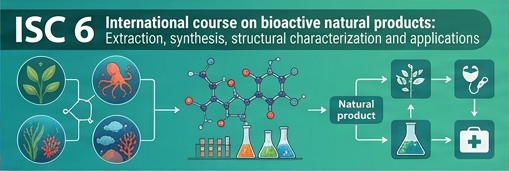
ISC. 6. International course on bioactive natural products: Extraction, synthesis, structural characterization and applications
General Information
Venue: Faculty of Sciences, Puerto Real Campus
Dates: July 13-17
Duration: 22h
Field of Knowledge: Organic Chemistry
Number of places: 20
Course Coordinator: Jesús García Zorrilla
Coordinator’s email: jesus.zorrilla@uca.es
Language: English
ECTS recognition is requested
Target Audience: Students and PDI
Course Description
Natural Products Chemistry is an interdisciplinary field linking organic and analytical chemistry with biochemistry, microbiology, biotechnology, and agricultural sciences, among others. It focuses on organic compounds produced by living organisms (plants, fungi, bacteria, and marine sources) through extraction, isolation, purification, structural characterization, and, when appropriate, synthesis or semisynthesis. Particular attention is given to secondary metabolites, molecules with crucial ecological roles and often relevant biological activity. For this reason, natural products remain a major source of lead compounds for drug discovery, while also driving innovation in cosmetics, nutraceuticals and food, and crop protection, supporting more sustainable solutions (e.g., bioherbicides). In a field where methods and scientific language are highly specialized, research commonly unfolds in an international, collaborative environment.
Against this background, this course provides an intensive programme with a theory-to-practice approach, adapted to students’ initial level. The course follows a realistic natural-products workflow: from extract preparation and compound purification, to structural elucidation, organic synthesis to obtain improved derivatives, and an introduction to bioassays aligned with pharmaceutical, cosmetic, or agrochemical applications. Teaching will involve experts from international universities and research centres, offering a current, application-oriented perspective. The main goal is to provide each participant with a solid, practical foundation to begin or strengthen skills in natural-products research and development. The course integrates Sustainable Development Goals (SDGs) of the 2030 Agenda, particularly those related to Good Health and Well-being (SDG 3), Responsible Consumption and Production (SDG 12), Climate Action (SDG 13), and Life Below Water and Life on Land (SDGs 14 and 15).
Course Objectives
-
Learn and apply core techniques for sample preparation and extraction, as well as the purification of bioactive natural products, including solvent selection and separation strategies.
-
Understand how organic synthesis (total synthesis and semi-synthesis) supports naturalproducts chemistry, either to access scarce compounds or to design derivatives with improved properties (activity, selectivity, stability, or physicochemical profile).
-
Gain practical introductory skills in structural characterization of organic molecules using NMR spectroscopy, mass spectrometry, and optical methods, with a critical, structure-oriented interpretation of data.
-
Learn the principles and experimental logic behind bioassays relevant to pharmacological and agronomic applications, from a practical standpoint.
-
Dispel common misconceptions found in everyday language and media narratives about “natural”, chemistry, and their applications, encouraging responsible communication.
-
Integrate in a naturally way equality, inclusivity and sustainability as transversal values in research practice.
Participant requirements
Applicants must have basic prior knowledge related to the course contents, including fundamental laboratory skills and introductory organic chemistry. A minimum academic or professional background in one of the following areas is strongly recommended: Chemistry, Chemical Engineering, Biochemistry, Biotechnology, Pharmacy, or closely related disciplines.
The course will be taught entirely in English. Therefore, participants are advised to have at least a B1 level of English proficiency. The coordinator and teaching staff are also able to communicate in Spanish and Italian, so native speakers of these languages may use them when necessary for clarification or support.
Course Programme
Day 1
| 10:00–11:00 | Session 1.1. Welcome / What are natural products? | José María González Molinillo |
| 11:00–12:00 | Session 1.2. Myths and facts about chemistry and natural products | Jesús García Zorrilla |
| 12:30–13:30 | Session 2.1. Methods for the preparation of extracts and purification of natural products | Marco Masi |
| 16:00–18:00 | Session 2.2. Practical preparation of extracts from plant material | Marco Masi |
Day 2
| 09:00–12:00 | Session 2.3. Practical purification of natural products by chromatographic method | Antonio Cala Peralta |
| 16:00–17:00 | Session 3.1. Use of organic synthesis in natural product chemistry | Francisco Javier Rodríguez Mejías |
Day 3
| 09:00–12:00 | Session 3.2. Practical training in organic synthesis for structural modifications | Francisco Javier Rodríguez Mejías |
| 16:00–18:00 | Session 3.3. Tour of the NMR and mass spectrometry facilities at the Faculty of Sciences, and introductory practical training in structural characterization of organic molecules | Antonio Cala Peralta |
Day 4
| 09:00–10:00 | Session 4.1. Drug discovery, from natural product isolation to bioassays | Annalisa Longobardi |
| 10:00–11:00 | Session 4.2. Agrochemical discovery, from natural product isolation to bioassays | Jesús García Zorrilla |
| 11:30–12:30 | Session 4.3. Bioassays with plant material for multipurpose applications | Mónica Fernández-Aparicio Ruiz |
| 16:00–18:00 |
Day 5
| 10:00–11:00 | Session 5.1. Equality, inclusivity and sustainability | Jesús García Zorrilla |
| 11:30–12:30 | Session 5.2. Evaluation | Jesús García Zorrilla |
| 12:30–13:30 | Session 5.3. Discussion, strengths and proposed improvements of the course, and distribution of certificates | Jesús García Zorrilla |
Assessment
- Submission of an assessable activity based on the results obtained during the practical sessions. A minimum grade of 5 out of 10 is required for this activity.
- Passing a final multiple-choice test covering the most essential theoretical content of the course, with a minimum grade of 5 out of 10.
Teaching Staff
| García Zorrilla, Jesús | Departamento de Química Orgánica, Universidad de Cádiz |
| González Molinillo, José María | Departamento de Química Orgánica, Universidad de Cádiz |
| Masi, Marco | Universidad de Nápoles Federico II (Italia) |
| Cala Peralta, Antonio | Departamento de Química Orgánica, Universidad de Cádiz |
| Rodríguez Mejías, Francisco Javier | Departamento de Química Orgánica, Universidad de Cádiz |
| Longobardi, Annalisa | CEINGE – Advanced Biotechnologies research center, Nápoles (Italia) |
| Fernández-Aparicio Ruiz, Mónica | Instituto de Agricultura Sostenible (IAS) del CSIC, Córdoba |
This course is supported and sponsored by:
Instituto de Biomoléculas de la Universidad de Cádiz (INBIO)
For any questions, please contact the coordinator of this course